What is gantry travel, and why rail length caps berth crane capacity
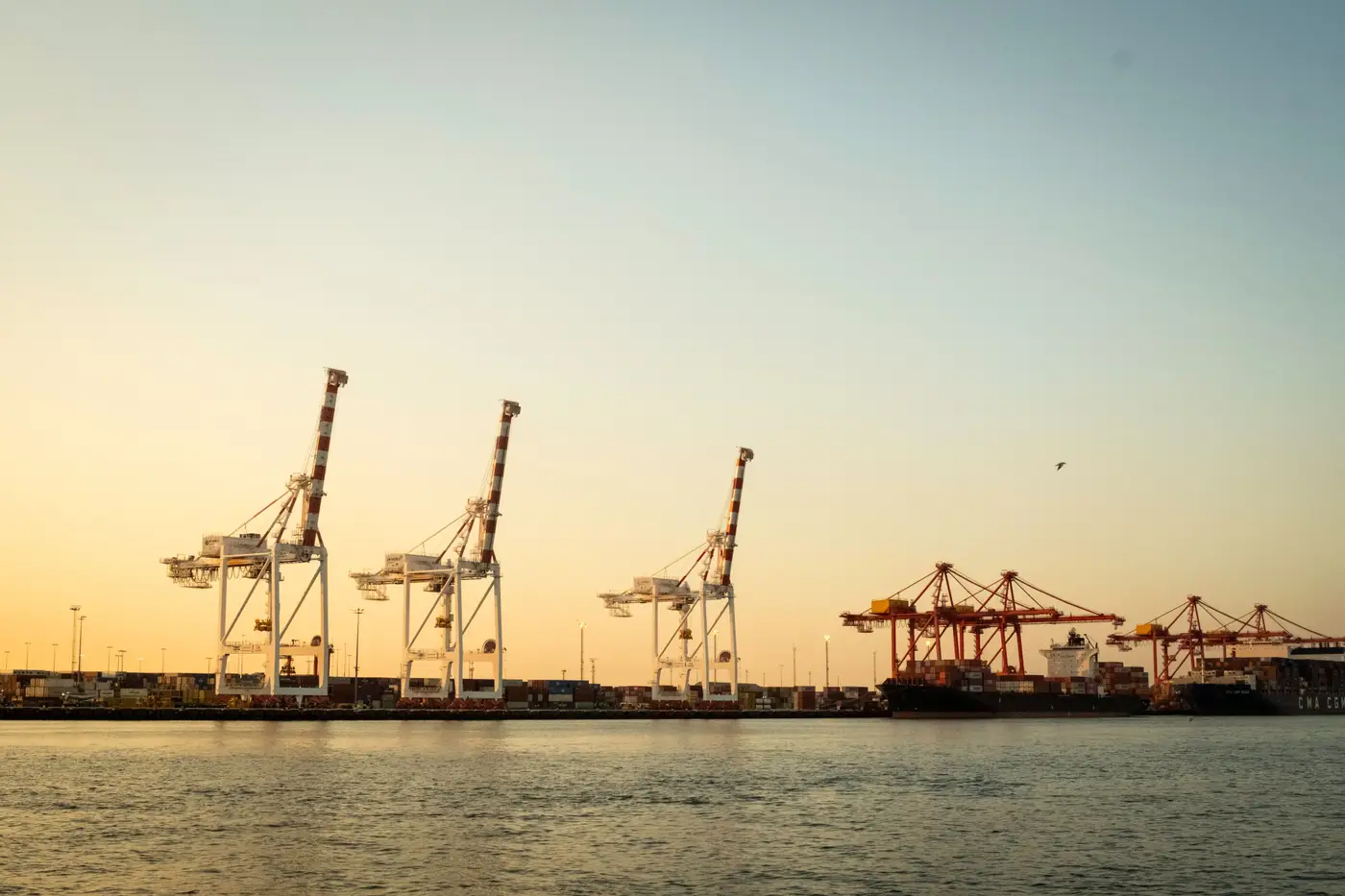
Gantry travel, plainly
Gantry travel is the crane's side-to-side roll along the quay, the motion that lets a ship-to-shore (STS) crane park over any hatch on a vessel without the vessel itself moving. Two long steel rails run parallel to the berth edge, set at a fixed gauge (commonly 30m, though gauges run wider on newer orders), and the crane's portal legs ride on bogies along those rails. Hoist, trolley and boom get the headlines; gantry travel is the axis that decides where on the ship the other three can reach.
Gantry travel also sets a limit that matters more if you're sizing up a competitor's terminal: how close two cranes can sit on the same rail without fouling each other.
Why rail length is the real constraint
A berth doesn't get sized by throughput targets first. It gets sized by rail length, and rail length gets divided by crane centers: the minimum spacing between adjacent crane centerlines that keeps two machines from colliding when both are gantrying at full tilt with booms up or trolleys run to the waterside stop.
Crane centers depend on a few things:
- Portal gauge and sill beam width, since wider portals need more clearance
- Backreach (how far the boom and machinery house hang over the landside rail) and the room an operator needs to clear a neighboring crane's counterweight during boom-up and boom-down cycles
- Whatever buffer the terminal builds in for simultaneous maintenance or breakdown recovery
On older terminals built around first- and second-generation Panamax cranes, 30m centers were common. Post-Panamax and the taller, wider-portal cranes handling today's ultra-large containerships tend to push that number toward 35m or more, bumper to bumper. A 700m berth that comfortably held 20-plus cranes on a tight older gauge might only take 18 on wider-portal replacements, even though the quay itself hasn't moved an inch.
That's the part that trips up anyone sizing a terminal from a satellite image or a port authority brochure. Berth length tells you the upper bound. It doesn't tell you the real crane count, because the count depends on which generation of crane sits on that rail and how the operator has spaced them.
Reading a competitor's berth
Sizing how many STS cranes a rival terminal can physically run takes three things: usable rail length (gross berth length minus end clearances and bollard setbacks), the gauge and portal width of the crane model installed, and the spacing the operator uses on site. That last one you only get by measuring crane-to-crane distance on current imagery, not by assuming a textbook figure.
Terminal operators rarely publish spacing. Equipment lists leak out in tender documents or OEM order announcements, but the as-built arrangement, how many cranes are sitting on that rail today and how far apart, is something you have to go measure terminal by terminal.
That's the gap a terminal-by-terminal crane inventory is built to close: a yearly count of STS and yard cranes across every terminal in a market, attributed by maker where the imagery shows it, with the rough height and reach that tell you which crane generation you're looking at. Cross that against rail length and you get a read on headroom, how much more a terminal could add before the berth runs out of room, not just what's parked there today.
A quick gut-check number
As a rough rule, divide usable rail length by crane centers, then subtract one for end effects, since the end cranes need clearance to the rail stops, not just to each other. A 600m rail at 35m centers gets you roughly 16 crane positions before you even start arguing about whether the terminal can staff and feed that many gangs at once. It's a ceiling, not a forecast, and it moves every time an operator swaps in a wider-gauge crane.
Want that ceiling checked against what's actually sitting on the rail at every terminal in your market? That's what Crane Fleet Mapping is for.