What is a crane serial number plate, and why satellite imagery can't read one
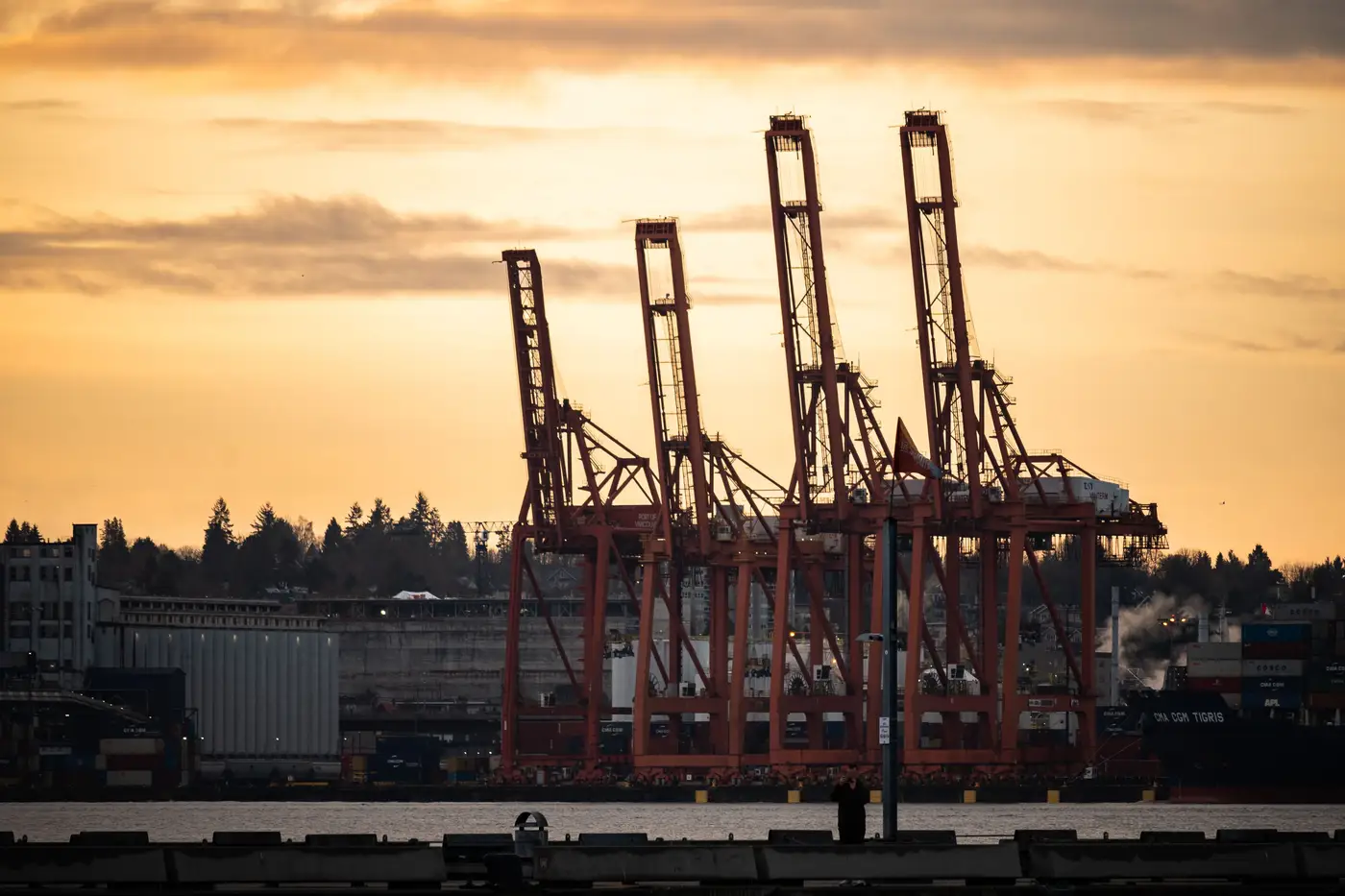
If you've ever stood under a ship-to-shore crane and looked up at the machine house, you've probably seen it: a small metal plate, usually aluminum or stainless steel, bolted or riveted somewhere near the operator access or the leg structure. It's stamped or engraved with the builder's name, a model designation, a serial number, sometimes a year of manufacture and a rated capacity. On RTGs and RMGs the same kind of plate usually sits on the control cabin or near the sill beam. It's the crane equivalent of a VIN plate on a truck. Whoever fabricated the machine put it there so a surveyor, an insurer, or a parts buyer could identify the exact unit decades later.
It's a good source if you're standing next to the crane with a notepad. It is not something a satellite or an aircraft can read, and the reason comes down to plain geometry rather than any limit of the analysis.
Why the plate is invisible from above
A typical builder's plate is roughly the size of a hardcover book, maybe 30 by 20 centimeters. At 0.5 m ground sample distance, which is the high end of what very high resolution satellite imagery delivers today, a single pixel already covers more ground than the entire plate. There's no amount of sharpening that recovers text that was never resolved in the first place.
But resolution isn't even the main obstacle. The plate is mounted on a vertical surface, usually at a height a technician can reach from a ladder or the nearest platform, and it faces outward or into the cab, not skyward. Overhead and near-vertical imagery is built to read horizontal surfaces: deck layout, boom position, container stacks, rail gauge. A plate on the side of a machine house, three stories up and facing the quay, simply isn't in the field of view no matter how many times you fly the pass.
What manufacturer attribution from imagery actually relies on
This is where people sometimes assume more than the method delivers. Attributing a crane to a builder from imagery is a silhouette match, not a label read. An analyst looks at boom profile (A-frame versus low-profile), portal leg clearance, backreach and outreach proportions, trolley and cab arrangement, sometimes a paint scheme if the terminal hasn't repainted since delivery. Several major builders have distinctive enough geometry that a trained eye, or a model trained on enough labeled examples, can call it with real confidence. A twin-boom STS with a particular leg rake reads differently than a single-boom unit from another yard.
The limit is real, though. Some builders share subcontracted steel fabrication, so hull geometry converges across brands. Terminals repaint and rebadge cranes after a refit, and a retrofit control cab can change the silhouette enough to throw off a visual match. That's why attribution gets flagged where the geometry is a clear fit to a known profile, and left unattributed where it isn't. Guessing a builder from a fuzzy match helps nobody; it just adds a wrong row to the inventory.
What that leaves you able to confirm, and what it doesn't
From an annual VHR or aerial pass you can reliably get a per-terminal count of ship-to-shore and yard cranes, a type breakdown (STS, RMG, RTG, mobile harbor crane), and rough dimensions, boom height and outreach, pulled from photogrammetry rather than a tape measure. Where the crane's geometry is a clean match to a known builder's design, you get an attribution. That's the whole stack of what imagery can responsibly claim.
What it can't give you is anything that only lives on the plate or in the OEM's own delivery paperwork: the exact model number, the serial number itself, the year the unit was commissioned, or a retrofit history. If you need that level of detail on a specific crane, someone still has to go stand under it. What the imagery buys you is everything above that: knowing which terminals in a market have how many cranes of which type and roughly which maker, updated once a year, without sending anyone to the quay.
That's the gap Crane Fleet Mapping is built to close: a terminal-by-terminal crane inventory with count, type, and manufacturer attribution where the geometry supports it, refreshed annually from the same imagery passes. If a terminal-by-terminal baseline is what your competitive tracking is missing, that's the dataset to start from.